
10K Type 2 Thermistor Chart: Unveiling the Key Specifications and Diverse Applications of a Versatile Temperature Sensor.
In the realm of temperature sensing, the 10K Type 2 thermistor stands out as a crucial component, offering precise and reliable temperature measurements. This comprehensive guide delves into the intricate details of the 10K Type 2 thermistor, providing a detailed overview of its specifications, applications, and circuit design considerations.
Contents
Thermistor Basics

Thermistors are temperature-sensitive resistors whose resistance changes significantly with temperature. They are made of semiconductor materials and are used in a wide range of applications, including temperature measurement, temperature compensation, and flow sensing.
Types of Thermistors
There are two main types of thermistors: positive temperature coefficient (PTC) thermistors and negative temperature coefficient (NTC) thermistors. PTC thermistors increase in resistance as temperature increases, while NTC thermistors decrease in resistance as temperature increases.
Applications of Thermistors
Thermistors are used in a wide range of applications, including:
- Temperature measurement
- Temperature compensation
- Flow sensing
- Overcurrent protection
- Voltage regulation
10K Type 2 Thermistor Specifications

10K Type 2 thermistors are characterized by their specific electrical and physical properties, designed to meet specific application requirements. These thermistors exhibit a predictable change in resistance over a defined temperature range, making them suitable for various temperature sensing applications.
Key specifications of a 10K Type 2 thermistor include:
Temperature Range
- 10K Type 2 thermistors typically operate within a temperature range of -55°C to +150°C.
- This wide temperature range allows for versatility in various applications, from low-temperature environments to moderate-temperature settings.
Resistance
- At 25°C, 10K Type 2 thermistors have a nominal resistance of 10,000 ohms (10kΩ).
- As the temperature changes, the resistance value changes predictably, enabling precise temperature measurements.
Accuracy, 10K Type 2 Thermistor Chart
- 10K Type 2 thermistors offer high accuracy in temperature measurement, typically within ±1% to ±5% of the nominal resistance value.
- This level of accuracy ensures reliable temperature readings, making them suitable for applications requiring precise temperature control.
Advantages
- Wide temperature range, suitable for various applications.
- High accuracy in temperature measurement.
- Relatively low cost and easy to use.
Disadvantages
- Limited temperature range compared to other thermistor types.
- Susceptible to self-heating effects at higher currents.
10K Type 2 Thermistor Chart

Thermistors are resistors whose resistance varies with temperature. A 10K Type 2 thermistor is a thermistor with a resistance of 10,000 ohms at 25°C. The resistance of a 10K Type 2 thermistor decreases as the temperature increases.
The following table shows the resistance values of a 10K Type 2 thermistor at different temperatures:
10K Type 2 Thermistor Resistance Chart
| Temperature (°C) | Resistance (Ω) |
|---|---|
| -50 | 1,235,927 |
| -40 | 528,425 |
| -30 | 225,621 |
| -20 | 95,643 |
| -10 | 40,533 |
| 0 | 17,175 |
| 10 | 7,347 |
| 20 | 3,128 |
| 25 | 2,486 |
| 30 | 1,962 |
| 40 | 1,229 |
| 50 | 765 |
| 60 | 474 |
| 70 | 294 |
| 80 | 183 |
| 90 | 114 |
| 100 | 71 |
| 110 | 44 |
| 120 | 27 |
| 130 | 17 |
| 140 | 10 |
| 150 | 6 |
This table can be used to determine the resistance of a 10K Type 2 thermistor at any temperature between -50°C and 150°C.
10K Type 2 Thermistor Applications
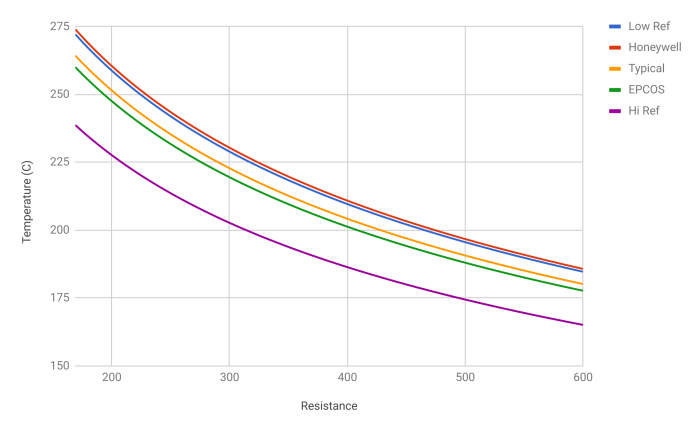
10K Type 2 thermistors are widely used in various electronic applications due to their unique characteristics. They are commonly employed in temperature sensing, temperature compensation, and overcurrent protection circuits.
Temperature Sensing
10K Type 2 thermistors are highly sensitive to temperature changes, making them ideal for temperature sensing applications. They are often used in temperature probes, thermometers, and thermal control systems.
The resistance of a 10K Type 2 thermistor decreases as the temperature increases. This negative temperature coefficient (NTC) behavior allows for precise temperature measurements over a wide range.
Temperature Compensation
10K Type 2 thermistors are also used for temperature compensation in electronic circuits. By placing a thermistor in series with a circuit component, the temperature-dependent resistance of the thermistor can be used to compensate for temperature-induced changes in the circuit’s performance.
For example, in a voltage reference circuit, a 10K Type 2 thermistor can be used to compensate for the temperature-dependent voltage drift of the reference voltage.
Overcurrent Protection
10K Type 2 thermistors can be used to provide overcurrent protection in electronic circuits. When the current through the thermistor exceeds a certain threshold, the thermistor’s resistance increases, limiting the current flow.
This property makes 10K Type 2 thermistors useful in protecting sensitive electronic components from damage caused by overcurrent conditions.
10K Type 2 Thermistor Circuit Design: 10K Type 2 Thermistor Chart
Thermistors can be used in a variety of circuit designs. One common application is as a temperature sensor. Thermistors can also be used in voltage regulation, current limiting, and other applications.
When designing a circuit with a thermistor, it is important to consider the following factors:
- The thermistor’s resistance at the desired operating temperature
- The thermistor’s power dissipation
- The circuit’s voltage and current requirements
Schematic Diagram
The following schematic diagram shows a simple circuit using a 10K Type 2 thermistor:
      +5V
      |
      R1 (10kΩ)
      |
    +--+
    |  |
    |  |
    |  |
    +--+
      |
      Thermistor (10K Type 2)
      |
      GND
In this circuit, the thermistor is used as a voltage divider with resistor R1. The output voltage of the circuit will vary depending on the temperature of the thermistor.
Purpose and Function
The purpose of this circuit is to create a simple temperature sensor. The output voltage of the circuit will be proportional to the temperature of the thermistor. This voltage can then be used to drive an analog-to-digital converter (ADC) or other circuit that can convert the voltage into a digital signal.
Component Values
The values of the components in this circuit are not critical. However, it is important to choose a value for R1 that will result in an output voltage that is within the range of the ADC or other circuit that will be used to convert the voltage into a digital signal.
Tips
Here are a few tips for designing circuits with 10K Type 2 thermistors:
- Use a thermistor with a resistance that is appropriate for the desired operating temperature.
- Consider the thermistor’s power dissipation when designing the circuit.
- Use a voltage divider with the thermistor to create a voltage that is proportional to the temperature.
- Use an ADC or other circuit to convert the voltage into a digital signal.
Final Conclusion

In conclusion, the 10K Type 2 thermistor proves to be an indispensable tool in a wide range of temperature-sensitive applications. Its exceptional accuracy, stability, and cost-effectiveness make it an ideal choice for temperature sensing, compensation, and protection circuits. By understanding the specifications, applications, and circuit design principles Artikeld in this guide, engineers can harness the full potential of this versatile component.
FAQ Section
What is the temperature range of a 10K Type 2 thermistor?
The temperature range of a 10K Type 2 thermistor typically spans from -50°C to 150°C.
What are the advantages of using a 10K Type 2 thermistor?
10K Type 2 thermistors offer high accuracy, stability, and cost-effectiveness, making them suitable for a wide range of applications.
How can I design a circuit using a 10K Type 2 thermistor?
Circuit design considerations for 10K Type 2 thermistors include selecting appropriate component values and understanding the impact of temperature on circuit behavior.
